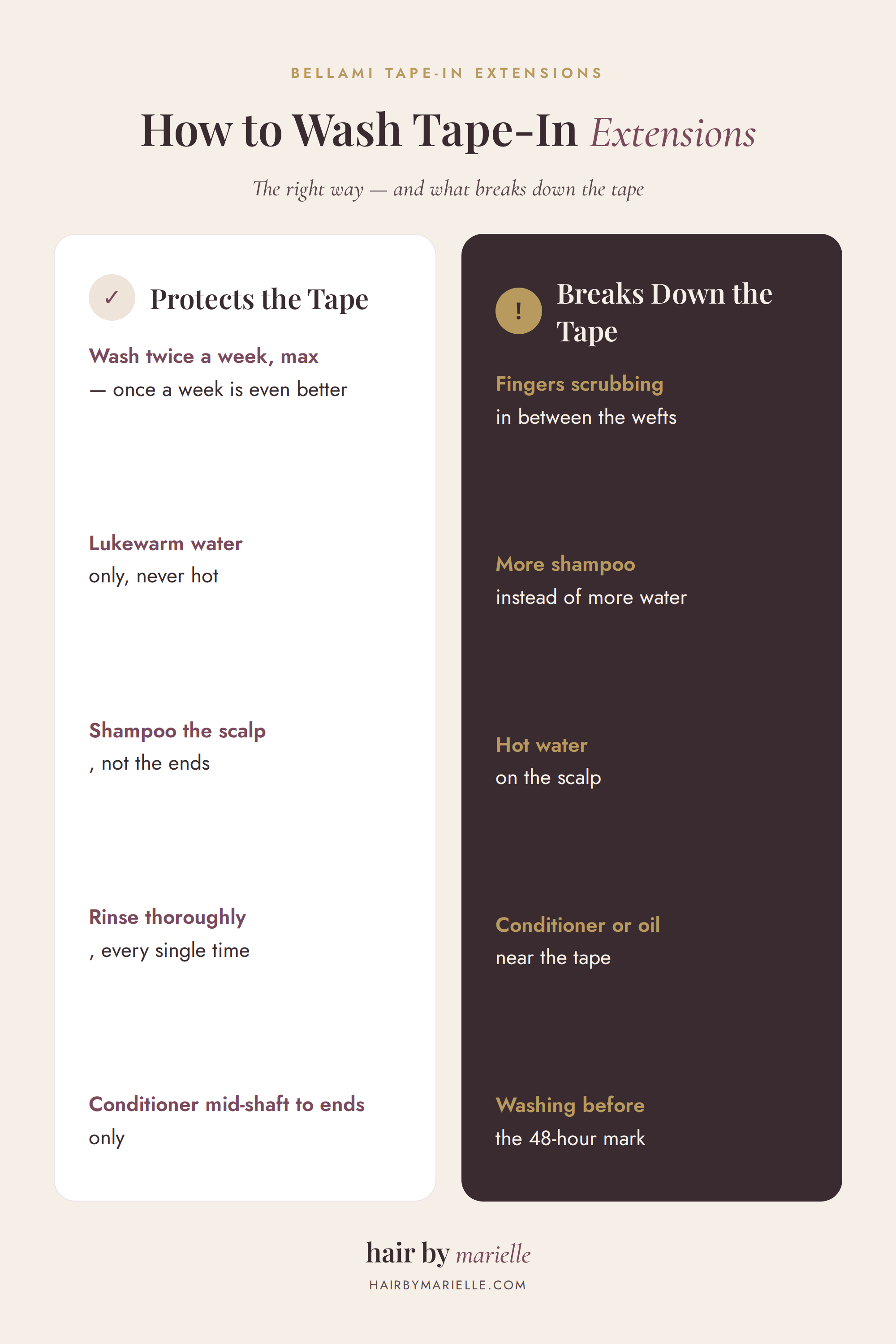
Wash tape-in extensions no more than twice a week — I personally wash mine once. The less you wash, the longer the hair and the tape bond both last. When you do wash, the goal isn't scrubbing everywhere — it's shampooing your scalp where the tape isn't, rinsing thoroughly, and keeping conditioner and oil away from the bonds entirely.
A quick note: this article contains affiliate links — as an Amazon Associate, I earn from qualifying purchases at no extra cost to you. I only point you to what I actually use behind the chair.
Why extensions need less washing than your natural hair
Extension hair isn't your natural hair — it doesn't get the natural oils your scalp produces, so washing it too often just dries it out and shortens how long it lasts. On top of that, every time you get the tape wet and work shampoo around it, you're breaking down the bond a little more. Keep washing to twice a week at the most. Most of my clients do great with once a week.
The right way to wash, start to finish
Focus your attention on the top section of your hair — your scalp, where the tape isn't applied. Apply a small amount of shampoo to your hand, emulsify it first, then work it into your saturated hair, scrubbing your scalp directly. Reach underneath to the nape of your neck too, since tape isn't applied right at the hairline back there either.
If it doesn't feel like it's sudsing enough, don't add more shampoo — that just causes buildup, which makes hair feel greasy without actually cleaning it better. Just spin around under the water for a second; you almost always need more water, not more product. Keep the water lukewarm — hot water dries out any hair, extensions or not.
You do not need to work your fingers in between the tape wefts. The shampoo rinsing through as it washes out is enough to clean everything else. Going in with your fingers just increases the odds you won't rinse thoroughly, and any shampoo left sitting near the scalp between tape ends will break the bond down, leave a tacky residue, and cause the tape to start sliding out. Rinse very well — that's the single biggest thing to get right.
My favorite shampoo and conditioner for extension clients specifically — sulfate-free, professional-grade, and it keeps the bond strength of the hair holding your tape resilient between move-ups.
See No. 4 on Amazon →See No. 5 on Amazon →
Where conditioner goes — and where it never should
Conditioner always goes midshaft to ends, saturated well, left to sit for a few minutes. If the pieces framing your face are lightened and feel a little more delicate, a small amount of leftover residue on your hands is fine there too. But conditioner should never get near where the tape is actually applied at your scalp — conditioner and oil act like a lotion there, and that breaks down the bond, which is exactly what causes the tape to eventually slide out.
The mistake that loosens the bond fastest
The biggest mistake I see is clients overthinking the wash and trying to get in between every weft with their fingers. You don't need to — the hair on top is what actually gets touched, played with, and dirty the most, so that's what needs the real cleaning. Shampoo gliding through the rest of your length as you rinse is enough. Going in between the wefts just risks leaving shampoo behind, which breaks down the tape and causes it to slide out.
Drying — and why less heat wins here
After washing: towel dry, spray in a detangler and heat protectant, then brush with a wet brush from ends all the way up to roots, making sure there's no matting between your natural hair and the extensions. The last bit of heat you put on your hair — extensions or not — is always the one that counts most, so aim for the least heat possible. If you know you won't be styling before bed, wash with enough time to let your hair air dry rather than going to sleep with it wet. If you do air dry, keep a brush nearby to catch any knots as it dries. Either way: towel dry, heat protectant, detangler, brush out — every single time.
My go-to detangler and heat protectant for wash day — it makes the ends-to-roots brush-out so much easier, especially right after washing when hair is most tangle-prone.
See it on Amazon →Wait 48 hours before the first wash
After a fresh install, you have to wait a minimum of 48 hours before washing your hair — and that includes anything that gets your scalp wet or sweaty, like a workout or getting caught in the rain. Your scalp needs to stay completely dry while the bonds set. I personally wait 72 hours with my own extensions, just to be safe, but 48 is the general rule.
The one ingredient blonde clients need to watch for
Nothing is secretly "bad" for tape-ins across the board, but there's one thing blonde clients specifically don't realize: oils like Moroccan Oil — and even Olaplex's own hair oil — are tinted yellow, and over time they'll tint blonde extensions yellow in a way toning can't fully correct. If you have blonde extensions, reach for a clear oil instead.
A clear oil that's safe for blonde extension clients — no yellow tint risk. I recommend it on the ends only, same as any oil or conditioner.
See it on Amazon →And while we're on blonde extensions: skip at-home purple shampoo. Extension hair is more porous than natural hair and grabs pigment far more aggressively — it can over-tone fast in a way that's hard to reverse. If your extensions start looking a little yellow, save the toning for your appointment instead of reaching for purple shampoo at home.
Every product above, together in one place — my curated Amazon list for extension wash day and nighttime care.
Shop the list →My full at-home routine, in one guide
The exact products I use and recommend, how often to use each one, and my simple wash-day routine — plus an interactive Wash Day Routine card for your phone.
No spam, ever — check your email to confirm and your free guide is on the way.
Quick answers
In the Livonia area and thinking about extensions? Find me here or book a consultation.